• Space/Science
  • GeekSpeak
  • Mysteries of
    the Multiverse
  • Science Fiction
  • The Comestible Zone
  • Off-Topic
  • Community
  • Flame
  • CurrentEvents

Recent posts

Sloppy Seconds BuckGalaxy January 16, 2026 7:24 pm (Flame)

Trump's irrational fixation on Greenland could lead to widespread conflict. BuckGalaxy January 14, 2026 10:48 pm (Flame)

Germany, Sweden, France and Norway announce joint military exercises with Denmark in Greenland BuckGalaxy January 14, 2026 10:12 pm (CurrentEvents)

Erich von Däniken, 1935 – 2026 podrock January 13, 2026 9:05 am (CurrentEvents)

It is the cowardice that has doomed us.... RL January 11, 2026 1:07 pm (CurrentEvents)

An opinion from our neighbors up north, eh... podrock January 11, 2026 9:14 am (CurrentEvents)

Murdering moms in mini-vans in Minneapolis Minnesota RL January 10, 2026 2:01 pm (CurrentEvents)

Have Republicans lost control of the House already? BuckGalaxy January 8, 2026 11:35 pm (CurrentEvents)

Who deleted my Grammar post? BuckGalaxy January 8, 2026 11:06 pm (Off-Topic)

In the park Homer ER January 8, 2026 3:05 pm (Off-Topic)

66 Global Organizations the US is Leaving BuckGalaxy January 8, 2026 11:21 am (CurrentEvents)

Well, there goes the Nobel Peace Prize ER January 6, 2026 6:39 am (CurrentEvents)

Home » Space/Science

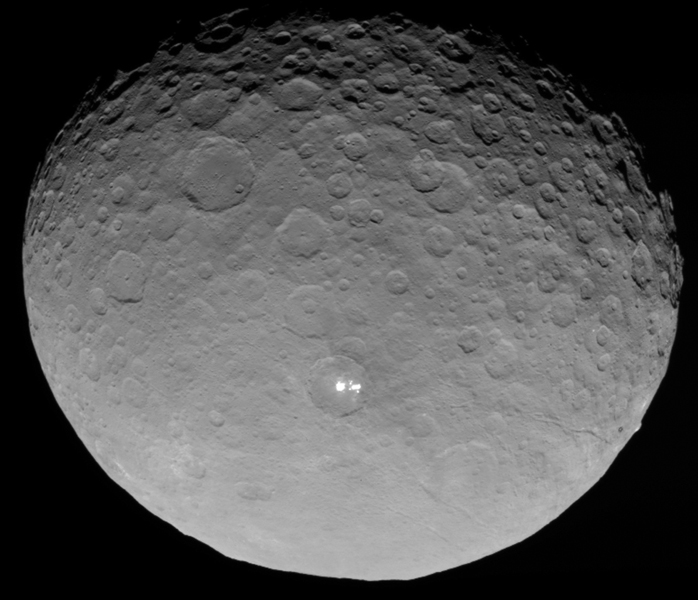
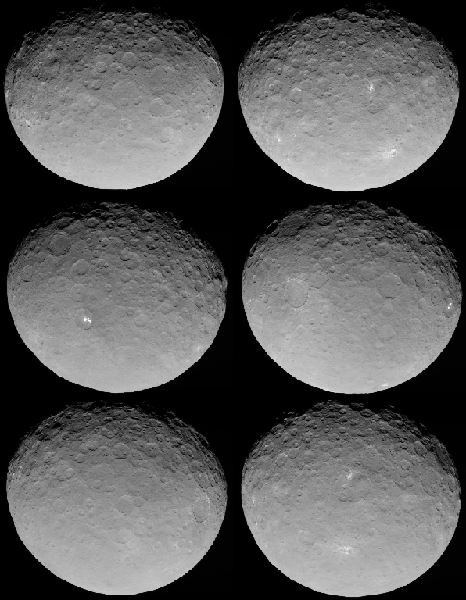
Latest images from Ceres May 11, 2015 8:05 am podrock

http://www.jpl.nasa.gov/spaceimages/images/mediumsize/PIA19547_ip.jpg

http://photojournal.jpl.nasa.gov/figures/PIA19547_fig1_thumb.gif

In this closest-yet view, the brightest spots within a crater in the northern hemisphere are revealed to be composed of many smaller spots. However, their exact nature remains unknown.

“Dawn scientists can now conclude that the intense brightness of these spots is due to the reflection of sunlight by highly reflective material on the surface, possibly ice,” said Christopher Russell, principal investigator for the Dawn mission from the University of California, Los Angeles.

These images offer scientists new insights into crater shapes and sizes, and a host of other intriguing geological features on the surface. The image resolution is 0.8 mile (1.3 kilometers) per pixel.

http://www.jpl.nasa.gov/news/news.php?feature=4582

Interesting linear structures showing up now as well! Note how they converge a bit in the location of the white spot crater. The hill on the right side is interesting too.

    Search

    The Control Panel

    • Log in
    • Register