• Space/Science
  • GeekSpeak
  • Mysteries of
    the Multiverse
  • Science Fiction
  • The Comestible Zone
  • Off-Topic
  • Community
  • Flame
  • CurrentEvents

Recent posts

Starfall BuckGalaxy June 2, 2026 6:30 pm (Space/Science)

It keeps getting worse... BuckGalaxy June 2, 2026 3:11 pm (Flame)

Starship Troopers on the Moon BuckGalaxy June 2, 2026 2:51 pm (Space/Science)

Musk wants self-sustaining space colonies BuckGalaxy May 31, 2026 6:11 pm (Space/Science)

Federal judge reopens Trump’s IRS case and demands to know if her court was defrauded. BuckGalaxy May 29, 2026 10:38 pm (Flame)

Ukraine winning the war BuckGalaxy May 29, 2026 11:14 am (CurrentEvents)

New Glenn explodes in big setback for Blue Origin BuckGalaxy May 28, 2026 7:54 pm (Space/Science)

Firefly set to visit Gruithuisen Domes BuckGalaxy May 28, 2026 4:32 pm (Space/Science)

Trump threatens another ally BuckGalaxy May 27, 2026 5:56 pm (CurrentEvents)

NASA Scientists Discover Material That Could Protect Jet Engines And Moon Equipment BuckGalaxy May 25, 2026 12:36 pm (Space/Science)

SEASON 5 - FOR ALL MANKIND BuckGalaxy May 24, 2026 11:28 pm (Science Fiction)

Trump's impulsive, ill-advised war has screwed the world BuckGalaxy May 19, 2026 1:46 pm (CurrentEvents)

Home » Space/Science

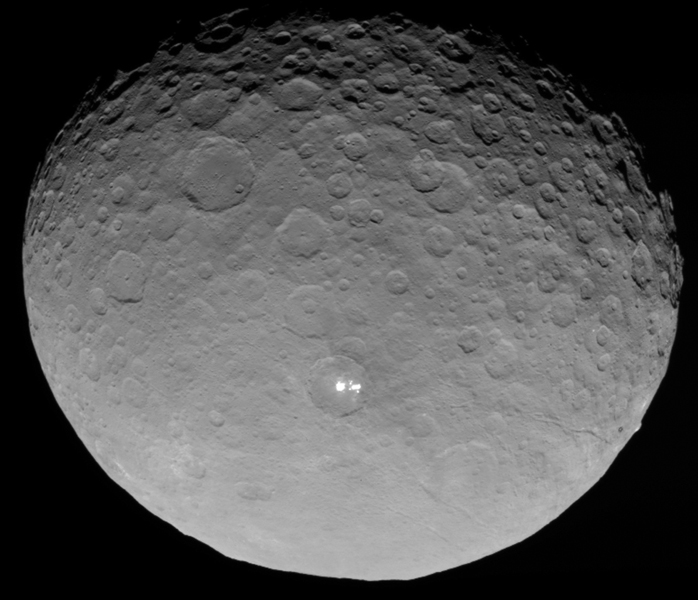
Latest images from Ceres May 11, 2015 8:05 am podrock

http://www.jpl.nasa.gov/spaceimages/images/mediumsize/PIA19547_ip.jpg

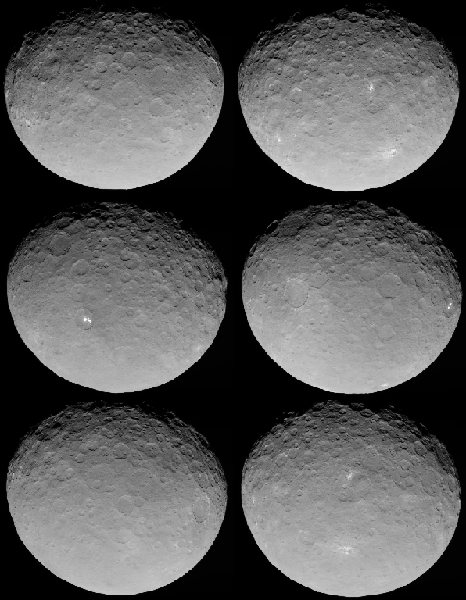
http://photojournal.jpl.nasa.gov/figures/PIA19547_fig1_thumb.gif

In this closest-yet view, the brightest spots within a crater in the northern hemisphere are revealed to be composed of many smaller spots. However, their exact nature remains unknown.

“Dawn scientists can now conclude that the intense brightness of these spots is due to the reflection of sunlight by highly reflective material on the surface, possibly ice,” said Christopher Russell, principal investigator for the Dawn mission from the University of California, Los Angeles.

These images offer scientists new insights into crater shapes and sizes, and a host of other intriguing geological features on the surface. The image resolution is 0.8 mile (1.3 kilometers) per pixel.

http://www.jpl.nasa.gov/news/news.php?feature=4582

Interesting linear structures showing up now as well! Note how they converge a bit in the location of the white spot crater. The hill on the right side is interesting too.

    Search

    The Control Panel

    • Log in
    • Register