• Space/Science
  • GeekSpeak
  • Mysteries of
    the Multiverse
  • Science Fiction
  • The Comestible Zone
  • Off-Topic
  • Community
  • Flame
  • CurrentEvents

Recent posts

Blue Origin halts New Shepard flights BuckGalaxy January 31, 2026 3:13 am (Space/Science)

Trouble on the way BuckGalaxy January 28, 2026 1:47 pm (CurrentEvents)

Being a tech bro gets you a commission and a uniform podrock January 28, 2026 11:16 am (CurrentEvents)

Artificial Intelligence ER January 28, 2026 6:56 am (Flame)

Emily Blunt's favorite sandwich. ER January 27, 2026 7:46 am (Comestible Zone)

hey hey SDG January 26, 2026 10:38 pm (6)

‘Yes, it’s going to crack’ - a spacecraft not everyone thinks is safe to fly BuckGalaxy January 23, 2026 10:42 am (Flame)

Trump’s Greenland Gambit Has Broken Brains Across Washington BuckGalaxy January 21, 2026 8:38 pm (Flame)

This is so strange, on so many levels. ER January 21, 2026 5:13 pm (Off-Topic)

What's in your wallet? ER January 19, 2026 8:10 pm (CurrentEvents)

Anne Applebaum: Trump’s Letter to Norway Should Be the Last Straw BuckGalaxy January 19, 2026 7:18 pm (Flame)

Sloppy Seconds BuckGalaxy January 16, 2026 7:24 pm (Flame)

Home » Space/Science

Mid-September boreal sea ice extrema September 15, 2023 7:28 am ER

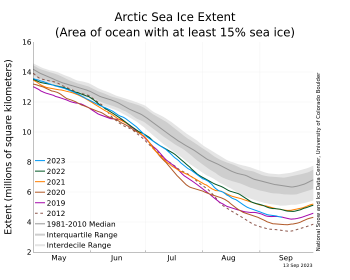
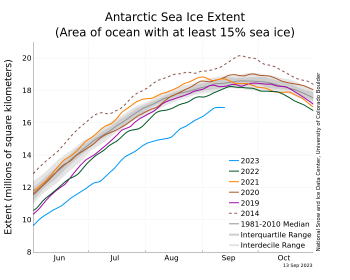
Both Arctic and Antarctic sea ice appear to be heading toward their respective seasonal limits, reaching the lowest extent at the end of summer in the north, and the highest extent as winter ends in the south. In the Antarctic, high variability typically characterizes the period around the maximum, but at present the sea ice extent is more than 1 million square kilometers (386,000 square miles) below the previous record low maximum set in 1986.

In the Arctic, this summer is the 5th lowest minimum in the satellite record, bested only by 2007, 2012, 2016 and 2020.
In the Antarctic, this year’s decline in sea ice for the winter maximum is a record for the satellite era.
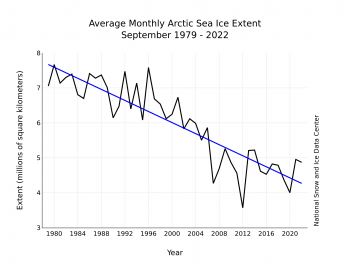
Early in October NSIDC will publish the monthly averages for sea ice extent time series compared to previous Septembers. The monthly average SIE metric is the most useful for revealing long term trends since it is smoothed out for short term changes due to wind, current and ice breakup and clumping. Here is the SIE time series compiled in October, 2022.
  • Why I do this. by ER 2023-09-15 08:15:18
    • I appreciate these posts by podrock 2023-09-15 09:21:53

    Search

    The Control Panel

    • Log in
    • Register