Looking back at 2023
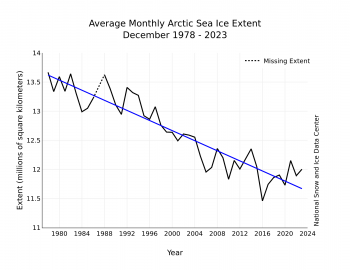
The extremely low Antarctic sea ice extent for most of the year was the most noteworthy characteristic of either polar region for 2023. At one point in mid-August, southern hemisphere sea ice was more than 1.80 million square kilometers (695,000 square miles) below the previous record low years (2022, 2002, or 1986 depending on the day of year), and more than 2.6 million square kilometers (1.00 million square miles) below the 1981 to 2010 average extent. The difference between 2023 daily extent and the 1981 to 2010 average was greater than 1 million square kilometers (386,000 square kilometers) for nearly the entire year. Several studies have argued that low sea ice extents in recent years for the Southern Ocean represent a response to unusually high temperatures in the upper ocean layer.In the Arctic, sea ice extent followed a pattern typical of the past decade, with persistently below-average extent in the northernmost Atlantic (Barents and Norwegian Seas) and large summer retreat along the eastern Siberian coast. However, the pace of sea ice decline (e.g. summer minimums or monthly average extents) has slowed since 2012, and the 2012 record low summer minimum has not been surpassed. While explanations have been offered to account for this “hiatus,” notably involving variations on ocean heat transport to the Arctic Ocean, questions remain.
The 2012 Sea Ice Extent was an outlier, an anomaly, even when considered against four decades of melting polar ice. Removing that data point from the record still leaves us with a bit shallower, but no less dramatic, drop of SIE in the satellite era.