• Space/Science
  • GeekSpeak
  • Mysteries of
    the Multiverse
  • Science Fiction
  • The Comestible Zone
  • Off-Topic
  • Community
  • Flame
  • CurrentEvents

Recent posts

Dividing up the World RobVG May 15, 2026 12:56 pm (CurrentEvents)

Foundation RobVG May 15, 2026 11:56 am (Science Fiction)

Przybylski’s Star: Still Bizarre After All These Years ER May 15, 2026 8:09 am (Space/Science)

Starship V3 set to make its first launch 6:30pm ET on Monday, May 19 BuckGalaxy May 12, 2026 4:52 pm (Space/Science)

Good idea, for what it's worth... BuckGalaxy May 11, 2026 11:00 pm (CurrentEvents)

Consequences of the Orange Moron's idiotic war BuckGalaxy May 11, 2026 1:36 am (CurrentEvents)

How are you supposed to win a war when you avoid killing people RobVG May 8, 2026 5:47 pm (CurrentEvents)

There's no way the Post WW2 order can be revived after Trump BuckGalaxy April 30, 2026 5:26 pm (CurrentEvents)

Trump had to be stopped from using nuclear weapons on Iran (edit - no evidence for claim... BAD RL!) RL April 21, 2026 7:57 pm (CurrentEvents)

New Glenn 3 flight profile BuckGalaxy April 18, 2026 12:08 am (Space/Science)

NASA's Moon Base User’s Guide BuckGalaxy April 16, 2026 3:10 pm (Space/Science)

Home » Space/Science

The December, 2016 numbers January 5, 2017 1:50 pm hank

From the National Snow and Ice Data Center (NSIDC)

Sea ice in the Arctic and the Antarctic set record low extents every day in December, continuing the pattern that began in November. Warm atmospheric conditions persisted over the Arctic Ocean, notably in the far northern Atlantic and the northern Bering Sea. Air temperatures near the Antarctic sea ice edge were near average. For the year 2016, sea ice extent in both polar regions was at levels well below what is typical of the past several decades.
…
Arctic sea ice extent for December 2016 averaged 12.10 million square kilometers (4.67 million square miles), the second lowest December extent in the satellite record. This is 20,000 square kilometers (7,700 square miles) above December 2010, the lowest December extent, and 1.03 million square kilometers (397,700 square miles) below the December 1981 to 2010 long-term average.
…
Through 2016, the linear rate of decline for December is 44,500 square kilometers (17,200 square miles) per year, or 3.4 percent per decade.

http://nsidc.org/arcticseaicenews/files/2017/01/Figure3-350×270.png
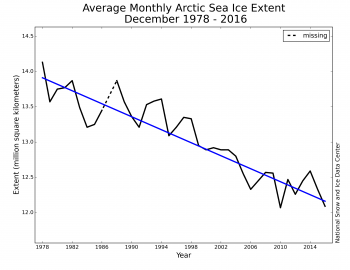
.

  • Thanks for posting this, hank by mcfly 2017-01-06 08:57:15
    • Thank YOU! It's nice to know someone else is paying attention. by hank 2017-01-06 10:00:36

    Search

    The Control Panel

    • Log in
    • Register