http://nsidc.org/arcticseaicenews/
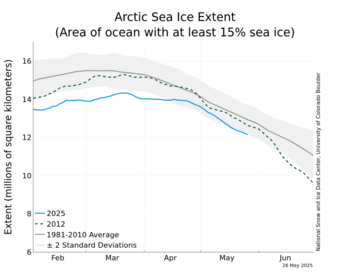
On February 25, 2015 Arctic sea ice likely reached its maximum extent for the year, at 14.54 million square kilometers (5.61 million square miles). This year’s maximum ice extent was the lowest in the satellite record, with below-average ice conditions everywhere except in the Labrador Sea and Davis Strait. The maximum extent is 1.10 million square kilometers (425,000 square miles) below the 1981 to 2010 average of 15.64 million square kilometers (6.04 million square miles) and 130,000 square kilometers (50,200 square miles) below the previous lowest maximum that occurred in 2011. This year’s maximum occurred 15 days earlier than the 1981 to 2010 average date of March 12.
Again, I must caution that historically, low ice levels in spring are a very poor predictor of ice conditions at the height of the summer melting season. Local conditions and weather, as well as ocean currents, can introduce a great deal of variability into the Arctic ice coverage. It is helpful to keep this in mind, and view these results in context with past conditions. The following graph summarizes the historical trends; note the dashed line representing the record low summer ice year of 2012, whose winter peak came both unusually high and late in the season.
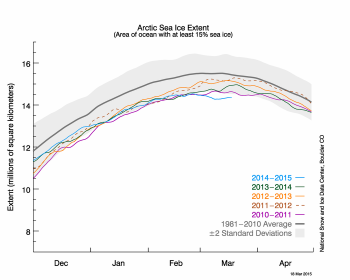
I’m no expert in Arctic climatology, but after studying it for several years now, I’m starting to develop an intuition about it. My own subjective prediction is that this year’s melt will be a big one, but will probably not exceed the 2012 “Perfect Melt”. Still, keep in mind, over the period we have been making satellite measurements, the low ice record in summer has been broken, on the average, about once every five years and the ten lowest September ice extents over the satellite record have all occurred in the last ten years.
***
For those of you interested in following global climate issues using the most precise, sensitive and objective indicator available, arctic ice data, I suggest the National Snow and Ice Data Center’s website at
http://nsidc.org/
For detailed review, analysis and interpretation of these results, plus comment and contributions from climate authorities and agencies worldwide, I highly recommend The Arctic Sea Ice Blog
http://neven1.typepad.com/