• Space/Science
  • GeekSpeak
  • Mysteries of
    the Multiverse
  • Science Fiction
  • The Comestible Zone
  • Off-Topic
  • Community
  • Flame
  • CurrentEvents

Recent posts

Sloppy Seconds BuckGalaxy January 16, 2026 7:24 pm (Flame)

Trump's irrational fixation on Greenland could lead to widespread conflict. BuckGalaxy January 14, 2026 10:48 pm (Flame)

Germany, Sweden, France and Norway announce joint military exercises with Denmark in Greenland BuckGalaxy January 14, 2026 10:12 pm (CurrentEvents)

Erich von Däniken, 1935 – 2026 podrock January 13, 2026 9:05 am (CurrentEvents)

It is the cowardice that has doomed us.... RL January 11, 2026 1:07 pm (CurrentEvents)

An opinion from our neighbors up north, eh... podrock January 11, 2026 9:14 am (CurrentEvents)

Murdering moms in mini-vans in Minneapolis Minnesota RL January 10, 2026 2:01 pm (CurrentEvents)

Have Republicans lost control of the House already? BuckGalaxy January 8, 2026 11:35 pm (CurrentEvents)

Who deleted my Grammar post? BuckGalaxy January 8, 2026 11:06 pm (Off-Topic)

In the park Homer ER January 8, 2026 3:05 pm (Off-Topic)

66 Global Organizations the US is Leaving BuckGalaxy January 8, 2026 11:21 am (CurrentEvents)

Well, there goes the Nobel Peace Prize ER January 6, 2026 6:39 am (CurrentEvents)

Home » Space/Science

Universal Expansion Rate may Vary . . . April 10, 2020 6:32 am DanS

Surprise! The Universe’s Expansion Rate may Vary from Place to Place
The new results challenge a core tenet of modern cosmology.

By Mike Wall

April 9, 2020 | The universe may not be the same in every direction after all.

The expansion rate of the universe appears to vary from place to place, a new study reports. This finding, if confirmed, would force astronomers to reassess just how well they understand the cosmos.


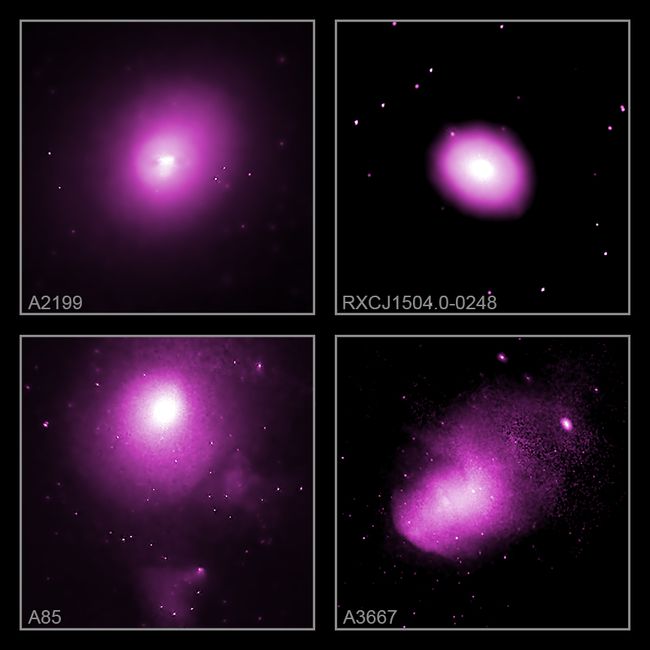
These four galaxy clusters were among hundreds analyzed in a large survey to test whether the universe is the same in all directions over large scales. The study results suggest the concept of an “isotropic” universe may not entirely fit.
(Image: © NASA/CXC/Univ. of Bonn/K. Migkas et al.)

“One of the pillars of cosmology — the study of the history and fate of the entire universe — is that the universe is ‘isotropic,’ meaning the same in all directions,” study lead author Konstantinos Migkas, of the University of Bonn in Germany, said in a statement. “Our work shows there may be cracks in that pillar.”

The universe has been expanding continuously for more than 13.8 billion years, ever since the Big Bang — and at an accelerating rate, thanks to a mysterious force called dark energy. Equations based on Einstein’s general theory of relativity suggest that this expansion is isotropic on large spatial scales, Migkas wrote Tuesday (April 7) in a blog post about the new study.
    Search

    The Control Panel

    • Log in
    • Register