• Space/Science
  • GeekSpeak
  • Mysteries of
    the Multiverse
  • Science Fiction
  • The Comestible Zone
  • Off-Topic
  • Community
  • Flame
  • CurrentEvents

Recent posts

Day 346 ER December 14, 2025 10:53 am (Space/Science)

In the eye of the beast ER December 14, 2025 7:40 am (Space/Science)

My New Year's Dissolution ER December 12, 2025 7:22 pm (CurrentEvents)

Theories about 16 Psyche BuckGalaxy December 12, 2025 12:34 am (Space/Science)

Mike Lindell, MyPillow Founder, Announces Run for Minnesota Governor BuckGalaxy December 11, 2025 10:30 pm (CurrentEvents)

Trouble in Paradise BuckGalaxy December 10, 2025 8:09 pm (CurrentEvents)

The Prisoner Survives BuckGalaxy December 9, 2025 9:16 pm (Off-Topic)

La Doctrina Monroe ER December 9, 2025 9:56 am (CurrentEvents)

Its a beautiful day in the neighborhood.... ER December 8, 2025 7:04 pm (Space/Science)

Alien Physiology and the Meaning of Life BuckGalaxy December 8, 2025 5:37 pm (Off-Topic)

Home » Space/Science

September Summary October 3, 2019 1:44 pm ER

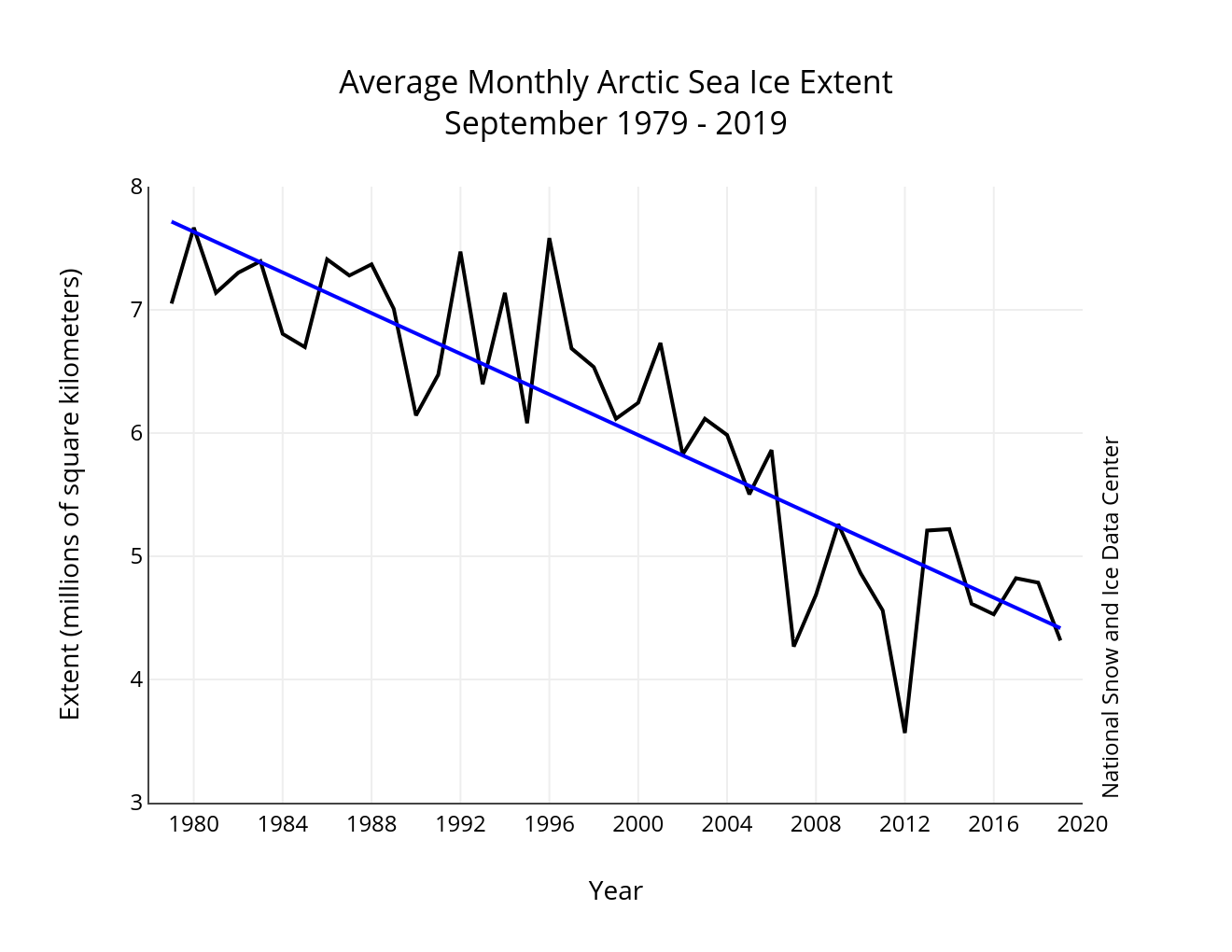
The data points are the September (minimum Arctic Sea Ice month) averages for Sea Ice Extent during the satellite era (1979-2019). Keep in mind the points plotted are not the sea ice minima, but the average SIE for the entire minimum month. This tends to smooth out a lot of the day to day and year to year variation.

You will note the regression drops from approximately 7.75 million sq km
to 4.5 million sq km in 40 years, a loss of 3.25 million km sq (about 42%). This averages out to 81,250 sq km per year. Or, we run out of summer ice at the N pole well before the end of this century–assuming these loss rates remain constant…
.

http://nsidc.org/arcticseaicenews/files/2019/10/Figure-3.png

    Search

    The Control Panel

    • Log in
    • Register