https://nsidc.org/arcticseaicenews/files/2019/04/Figure3-350×270.png
Sea ice extent maximum in the Arctic occurs in mid-March.
Although the SIE varies wildly from day to day due to local weather conditions, the average SIE for the entire month can be compared with the same metric for previous Marches in past years, giving us a good look at the overall trend of ice loss during the satellite era. Although the slope of the regression is only about a quarter of the value for the September measures (the height of the melt season) it only underscores the fact that no matter WHEN we look, the summer Arctic ice pack is vanishing, and will probably be gone altogether by mid-century. By the end of this century, its safe to say the entire Arctic Ocean will be ice free year ’round.
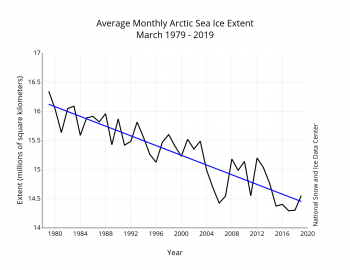
The net change in sea ice extent between the beginning and end of March was small, which is typical for the month. Sea ice extent increased during the first part of the month to the annual maximum on March 13 and then declined through the remainder of the month.
The 1979 to 2019 linear rate of decline for March ice extent is 41,700 square kilometers (16,100 square miles) per year, or 2.7 percent per decade relative to the 1981 to 2010 average.