• Space/Science
  • GeekSpeak
  • Mysteries of
    the Multiverse
  • Science Fiction
  • The Comestible Zone
  • Off-Topic
  • Community
  • Flame
  • CurrentEvents

Recent posts

Rocket man BuckGalaxy December 1, 2025 9:54 pm (CurrentEvents)

Yesterday was the 332nd day of the year 2025 ER November 30, 2025 1:41 pm (Space/Science)

All I know is what I see on the Internet. ER November 30, 2025 7:21 am (CurrentEvents)

I'm a California Man BuckGalaxy November 27, 2025 2:35 pm (CurrentEvents)

Collapse of the service access platform at Site 31 in Baikonur? BuckGalaxy November 27, 2025 12:54 pm (Space/Science)

Why the reflections? ER November 27, 2025 8:16 am (GeekSpeak)

So you Millennials think the world has given you a raw deal? ER November 25, 2025 5:27 pm (Off-Topic)

This is not a drill. NOT a drill. General Quarters, General Quarters. All hands man your battle stations. ER November 24, 2025 4:58 pm (CurrentEvents)

Xi called Trump RobVG November 24, 2025 10:26 am (CurrentEvents)

I thought this was fake news when I first saw it online BuckGalaxy November 23, 2025 10:13 pm (Space/Science)

And the worms ate into his brain BuckGalaxy November 23, 2025 7:37 pm (CurrentEvents)

Cracks propagate podrock November 22, 2025 8:54 pm (CurrentEvents)

Home » Space/Science

Cleaning Optics January 2, 2012 2:19 pm RobVG

The Arkansas Sky Observatory is one of the most referenced sites when it comes to optics cleaning.

I have a few nitpicks about the advice though. I don’t think that brushing the dust first with a hardware store paintbrush is a good idea, no matter how “soft” it is. If you feel you must brush it, a camel’s hair brush intended for camera cleaning would be a better choice.

Instead of first wiping the surface of a corrector plate with a moist cotton pad, I’d mist it with cleaning solution to wash any loose dust particles from the plate.

In the Celestron Knowledge Base , they recommend using canned or filtered compressed air to remove any dust.

Me? I prefer the “frost” method. If you live in an area with cold winter weather, wait until the temperature drops into the 20′s and leave your scope out all night. Moisture will form on the corrector plate and then freeze. The expansion of the forming frost will gently lift the dust particles off the plate. When the sun comes up, point the tube downward so the melting ice washes the dust away and doesn’t enter the plate frame.
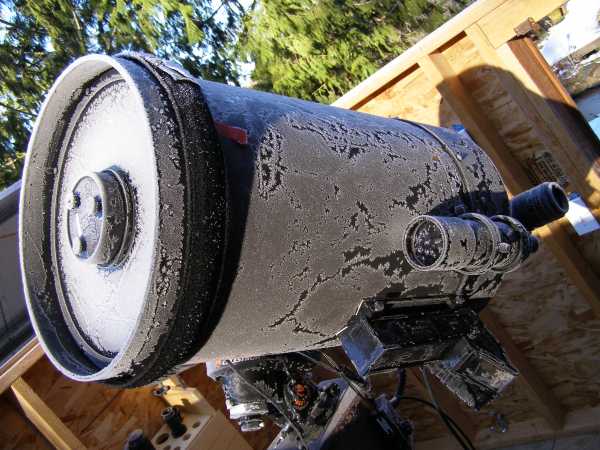
Of course I’m not serious but it sounded good didn’t it? ;) I left the roof open thinking I would get out of bed to view Saturn in the early morning hours. Forgot to set the alarm…

  • That's the first proof of water on Saturn I've seen. by bowser 2012-01-03 22:10:50
    • "Arkansas Sky Observatory" and "Celestron Knowledge Base" are links n/t by RobVG 2012-01-02 15:53:05
      • Well yeah, they're underlined. ;-) n/t by Robert 2012-01-03 09:46:00
        • Indeed n/t by RobVG 2012-01-03 10:28:08
      • Cool 'Scope. by ER 2012-01-02 15:23:52
        • Very Punny n/t by RobVG 2012-01-02 15:50:33
          • It looks like a really ice instrument. by ER 2012-01-02 18:46:30
            • It's an 11" SCT by RobVG 2012-01-02 20:12:28
              • I used to have one on my 3" rich-field refractor, which I now use for birding, and it was a ... by ER 2012-01-02 20:43:39

        Search

        The Control Panel

        • Log in
        • Register