http://www.skyandtelescope.com/wp-content/uploads/Sn-NGC-6945-Gianluca-animation.gif

22 Mly away in the “Fireworks Galaxy”, NGC 6946. Look for the blinker in the UR quadrant of the comparison images above. The brightness of the two galaxy images is not the same, the exposure for the discovery image is slightly longer than the one for the baseline. Keep in mind, all the field stars in those images are foreground stars in our own Milky Way galaxy. Except for the SN itself, none of the stars in the external galaxy is visible at all. It is much too far away. All we see is their combined glow.
Just one star blowing up, with an explosion of comparable brightness to the hundreds of billions of other stars in that galaxy. And the SN will continue this outburst for weeks, gradually fading to obscurity, as its atomic fragments and heavy elements are scattered back into the interstellar medium to provide material for a new generation of stars. We are not just witnessing the death of a star, but the creation of matter–heavy elements from the primordial hydrogen, by thermonuclear fusion and neutron absorption–nucleogenesis.
Now that’s what I call a REAL creation myth!
Most galaxies like ours seem to average about one SN per century. For some reason, this particular galaxy seems to generate a lot more (see article below).
http://www.skyandtelescope.com/astronomy-news/observing-news/possible-bright-supernova-discovered-in-fireworks-galaxy-ngc-6946/?utm_source=newsletter&utm_campaign=sky-mya-nl-170519&utm_content=945395_EDT_SKY_170519&utm_medium=email
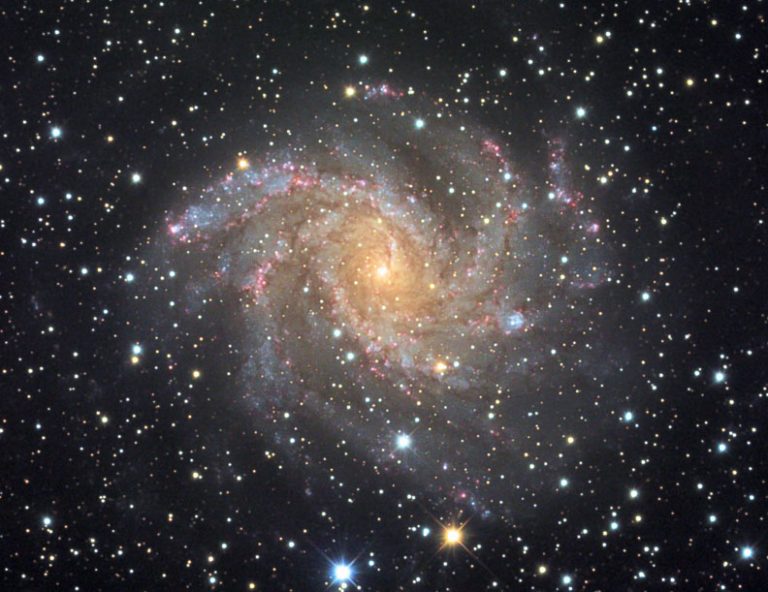
Professional false color image of this galaxy (SN not shown).
http://www.skyandtelescope.com/wp-content/uploads/ngc6946-Jim-Misti-768×592.jpg
(Update, May 14: Good news! According to ATel #10376, a spectrum taken of the object “is consistent with that of a young type IIP supernova at one week before the maximum light.” This means that our “new star” was a massive supergiant that is no more.)