http://news.yahoo.com/glacier-north-greenland-breaks-off-huge-iceberg-200048995.html
“It’s dramatic. It’s disturbing,” said University of Delaware professor Andreas Muenchow, who was one of the first researchers to notice the break. “We have data for 150 years and we see changes that we have not seen before.”
“It’s one of the manifestations that Greenland is changing very fast,” he said.
Researchers suspect global warming is to blame, but can’t prove it conclusively yet. Glaciers do calve icebergs naturally, but what’s happened in the last three years to Petermann is unprecedented, Muenchow and other scientists say.
“This is not part of natural variations anymore,” said NASA glaciologist Eric Rignot, who camped on Petermann 10 years ago.
Northern Greenland and Canada have been warming five times faster than the average global temperature, Muenchow said. Temperatures have increased there by about 4 degrees Fahrenheit in the last 30 years, Scambos said.
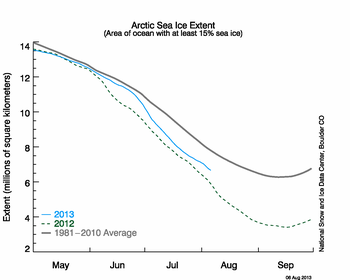
It’s more than glaciers in Greenland that are melting. Scientists also reported this week that the Arctic had the largest sea ice loss on record for June.
And speaking of the June numbers (from the NSIDC website)
Comparing June 2012 with previous Junes…
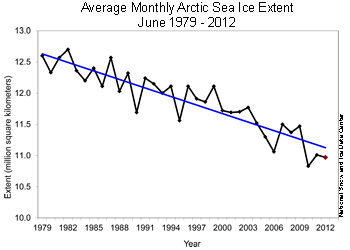
Sea ice cover reaches its yearly minimum in mid-September, and figures are usually posted at NSIDC early in October, along with comparisons with earlier years. Data for past years is also archived there so you can display charts of long-term trends in sea ice for every month of the year.
http://nsidc.org/arcticseaicenews/