The minimum extent of Arctic sea ice is in mid-September.
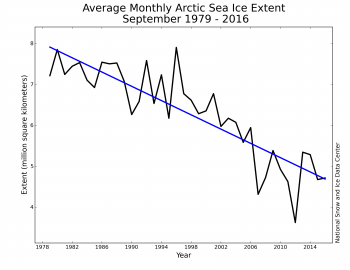
Shortly after, the Arctic starts to freeze again as winter progresses, usually reaching a maximum ice extent in mid-March, after which the melt season begins again. This year, the ice shrank to its second lowest point since satellite records became available, (with only the exception of the record low extent of 2012). The average ice extent for the entire month of September wasn’t quite that extreme, although it certainly fits the overall trend we’ve been seeing for the last four decades–a drop of about 1.3% per year. See the September graph below, which compares Sep/2016 ice extent with all the other Septembers in the satellite record.
http://nsidc.org/arcticseaicenews/files/2016/10/monthly_ice_09_NH-350×270.png
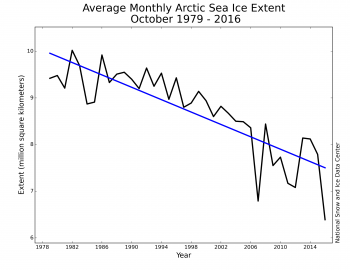
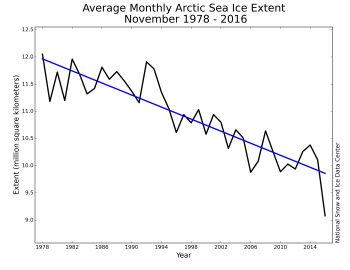
However, since mid-October of 2016, the post-September recovery in ice extent we usually see in the fall seems to be much slower than usual, with ice levels falling even below the 2012 record year! Yes, the Arctic is freezing over again, but not as fast or as much as it has in the past. The difference is pretty dramatic, as the graphs below show.
And keep in mind, the values on the y-axes are not some abstract anomaly figure, they are actual millions of square kilometers.
http://nsidc.org/arcticseaicenews/files/2016/11/Figure3-1-350×270.png
http://nsidc.org/arcticseaicenews/files/1999/12/monthly_ice_11_NH-350×270.png
The National Snow and Ice Data Center will soon be publishing the graph for the December, 2016 ice extent average. I will post it here, so you can compare it with these figures from the last few months.