• Space/Science
  • GeekSpeak
  • Mysteries of
    the Multiverse
  • Science Fiction
  • The Comestible Zone
  • Off-Topic
  • Community
  • Flame
  • CurrentEvents

Recent posts

Rocket man BuckGalaxy December 1, 2025 9:54 pm (CurrentEvents)

Yesterday was the 332nd day of the year 2025 ER November 30, 2025 1:41 pm (Space/Science)

All I know is what I see on the Internet. ER November 30, 2025 7:21 am (CurrentEvents)

I'm a California Man BuckGalaxy November 27, 2025 2:35 pm (CurrentEvents)

Collapse of the service access platform at Site 31 in Baikonur? BuckGalaxy November 27, 2025 12:54 pm (Space/Science)

Why the reflections? ER November 27, 2025 8:16 am (GeekSpeak)

So you Millennials think the world has given you a raw deal? ER November 25, 2025 5:27 pm (Off-Topic)

This is not a drill. NOT a drill. General Quarters, General Quarters. All hands man your battle stations. ER November 24, 2025 4:58 pm (CurrentEvents)

Xi called Trump RobVG November 24, 2025 10:26 am (CurrentEvents)

I thought this was fake news when I first saw it online BuckGalaxy November 23, 2025 10:13 pm (Space/Science)

And the worms ate into his brain BuckGalaxy November 23, 2025 7:37 pm (CurrentEvents)

Cracks propagate podrock November 22, 2025 8:54 pm (CurrentEvents)

Home » Space/Science

The March weather report April 7, 2015 2:28 pm ER

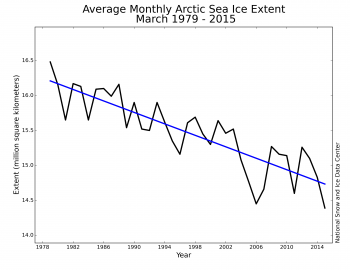
March is normally the highest sea ice extent month in the Arctic Ocean. Here is Mar 2015 compared to Marches past (NSIDC). Yes, its a record low for the satellite era.

http://nsidc.org/arcticseaicenews/files/2015/04/monthly_ice_NH_03-350×270.png
.

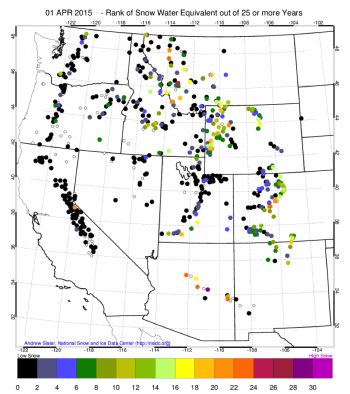
You know all that snow that fell in the East this winter? Here’s where it all came from.

http://nsidc.org/arcticseaicenews/files/2015/04/snow-350×394.png
.

NSIDC scientist Andrew Slater maintains regular updates of western U.S. mountain snowpack conditions using data from the SNOTEL (snowpack telemetry) system – a network of automated sensors that measure snow water equivalent. The automated SNOTEL sites are complemented by snowcourses, where snow water equivalent is measured manually on a periodic basis.

Typically, the snowpack peaks around April 1. As seen in Figure 5, the April 1 snowpack over most of the western United States is far below average. At many sites, snow water equivalent is at historic lows for this time of year.

    Search

    The Control Panel

    • Log in
    • Register